2024 (work in process), Interactive Simulation, Video Installation
Viewing copy on request
Viewing copy on request
> Concept
ESHRAQ is a modular computational model designed for meditations on forms and functions that rule the natural world. These models are derived from real-world phenomena, sampled, distilled, and synthesized to unravel and illuminate complex systems through computation.
ESHRAQ is philosophically influenced by Suhrawardi’s Illuminationist philosophy, which focuses on “Knowledge by Presence” — a direct, intuitive understanding of reality beyond discursive reasoning.
This work is continually shared and developed through a blog, which serves as an open notebook for thoughts, updates, and reflections. For a deeper dive into the concepts and progress behind ESHRAQ, visit eshraq.io
> Synopsis
ESHRAQ (Work in Process) is a speculative video installation that asks: If the Persian philosopher Shahab al-Din Suhrawardi (12th-century Iran) had a computer, what would he build? The work draws on his Illuminationist philosophy, where reality is articulated as degrees of light and knowledge is gained through direct, unmediated encounter known as “knowledge by presence.” Suhrawardi integrated ancient Persian motifs from Zoroastrian angelology into Islamic philosophy, alongside Platonic and Neoplatonic thought. Within his hierarchy of lights, complexity can be understood as levels of visibility and illumination. In ESHRAQ, these ideas are reimagined through computation, simulation, and game systems, while history is approached as a non-linear field.
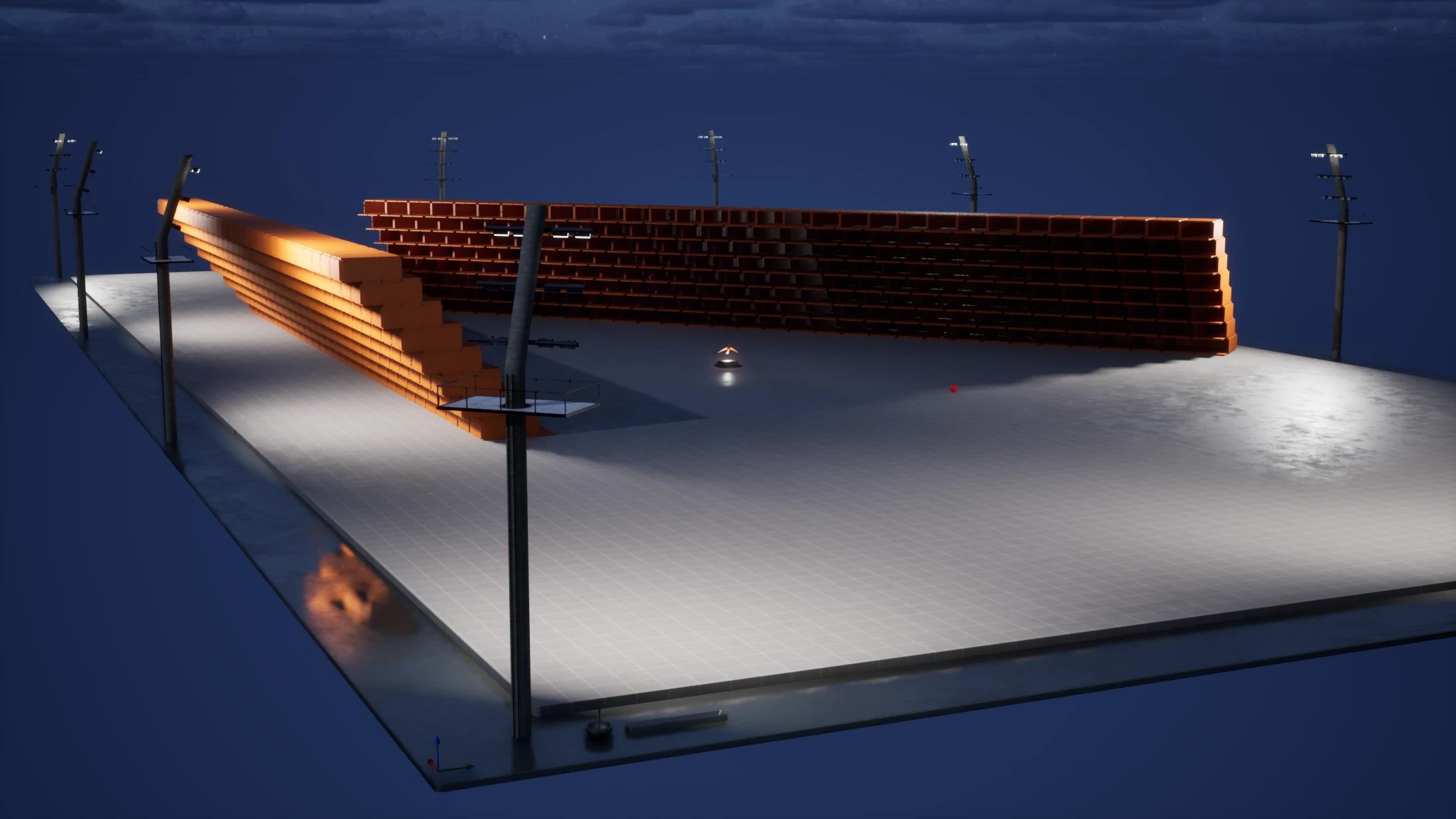
The work opens at the Ziggurat of Ur, reconstructed as an architectural network introducing the ontology. Airships descend from a luminous sky, releasing modular structures and agents awaiting possession by “souls.” These moments translate Suhrawardi’s metaphysics into operational mechanics, where illumination is both medium and structure.
This translation of medieval cosmology into digital systems engages with ideas from Reza Negarestani, whose thoughts on computational reason and the re-engineering of philosophy deeply informs the artist’s practice. The integration of philosophy with digital world-building also seeks to understand game worlds through a lens not shaped by Western traditions.
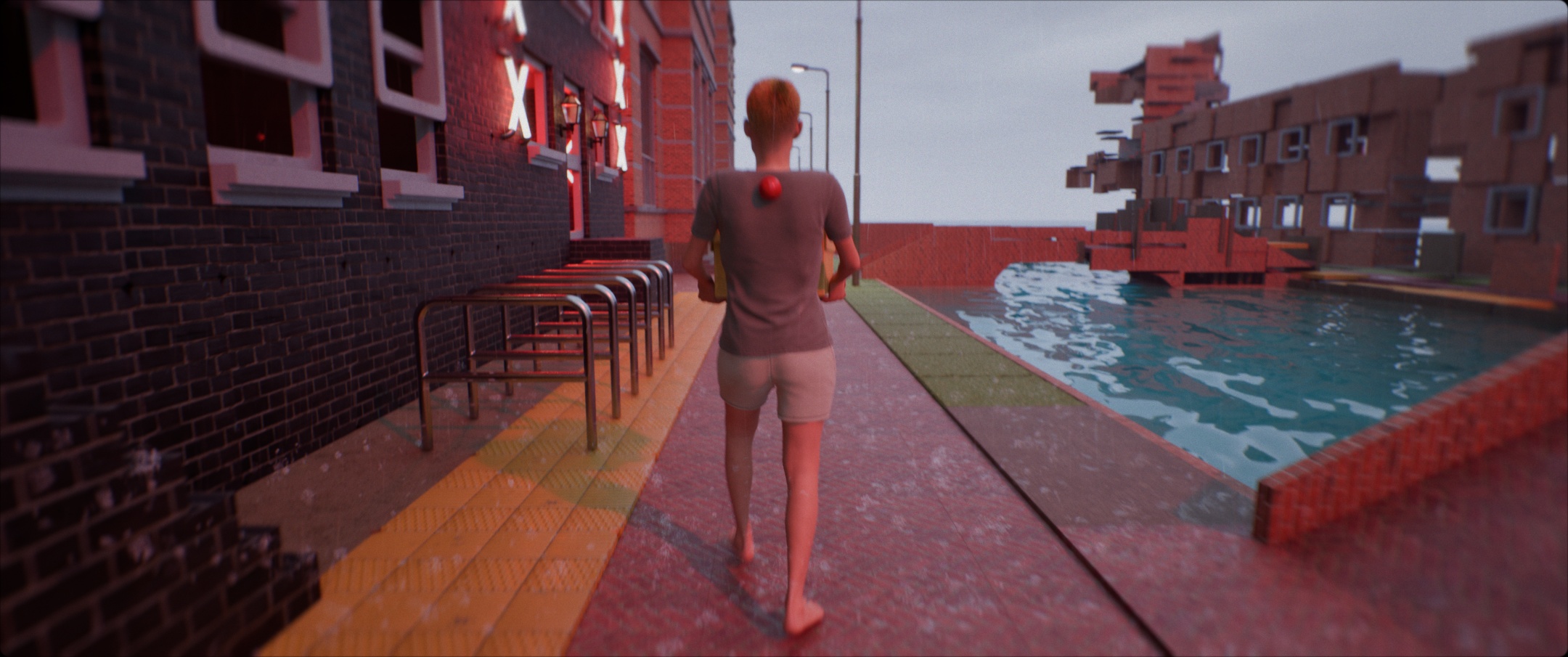
Through cinematic sequences, dynamic simulation, and layered narrative, ESHRAQ stages encounters between mythic beings, political histories, and speculative architectures. The wandering voice of a “Mythic George Bush” soul recalls events around the Ziggurat, while a fictional Amsterdam museum sequence follows an agent through surreal routines in art spaces and hidden vaults. These “naked” souls speak to themselves, revealing inner tensions and contradictions. Their fragmented narratives merge histories of war, personal memory, and mythology.
Rooted in interactive simulation, ESHRAQ extends the artist’s previous works, blending cinematic language and game logic. It offers a metaphysical laboratory where ontologies are playable, knowledge is experiential, and Illuminationist thought is reconfigured as living, computational systems.
> Stills (Film)


> Videos
> Screenshots (simulation)




> Credits
Research Assistant - Will Scarlett
Sound design & Music - Shahin Entezami
Graphic Design - Danial Alemasoum
3D art assistant - Babak Modarresi
Voice Actor - Zehra Eekhout
Thanks to Molly Palmer & Shreya de Souza
Powered by Unreal Engine
Supported by
Amsterdam Fonds voor de kunst, Amarte Fonds
and Mondriaan fonds